

Why Scrolling Leaves You Drained
Tired From Standing Still
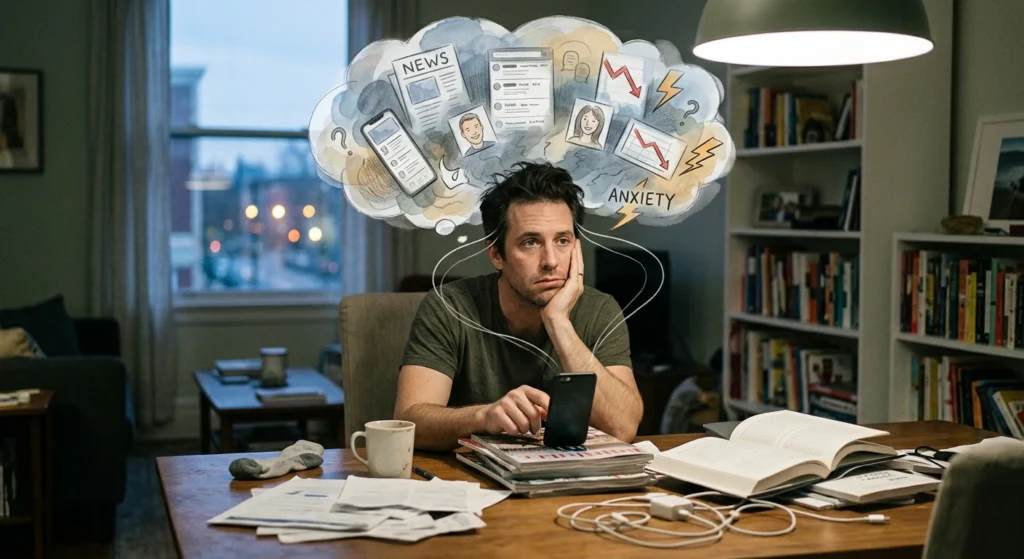
You didn’t lift anything heavy today. You didn’t run anywhere. You spent most of the day sitting, scrolling, half-watching, half-reading — and yet by evening, you feel like you’ve been through something. A specific kind of tired that doesn’t come from effort. It comes from input.
This is the strange exhaustion of modern life: you can do almost nothing physically and still end the day feeling completely drained, simply from the sheer volume of information that passed through your mind.
Also Read: The Myth of Multitasking: Why Doing Less at Once Gets More Done
A Mind Built for a World That No Longer Exists
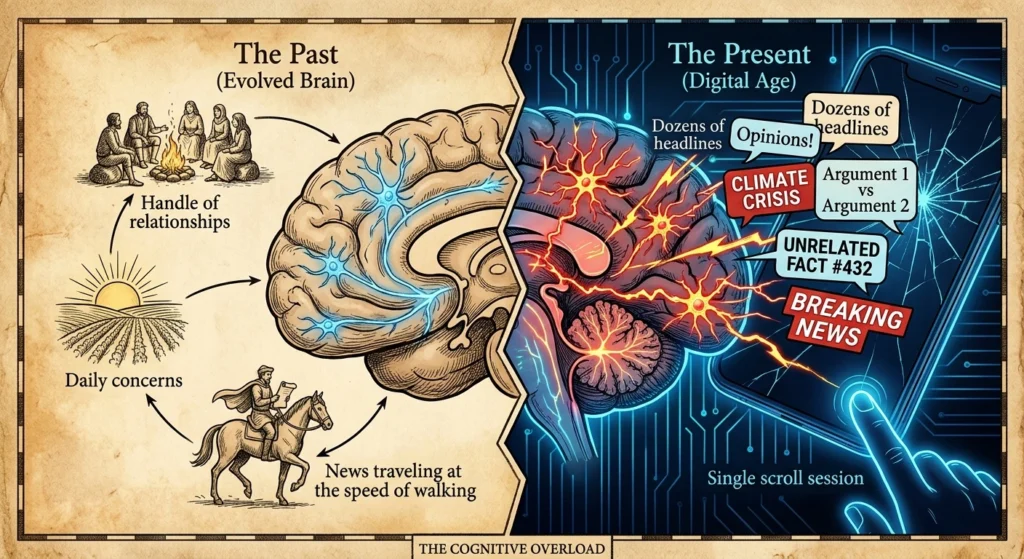
The human brain evolved to process a relatively small, slow stream of information — a handful of relationships, a limited set of daily concerns, news that traveled at the speed of a person walking. It was never designed for the volume it now absorbs in a single scroll session: dozens of headlines, opinions, crises, arguments, and unrelated facts, all competing for the same small amount of attention.
The result is a kind of fatigue with no clear cause — content fatigue — the mental exhaustion that comes not from any single piece of information, but from the accumulated weight of consuming far more than the mind was built to metabolize.
What Constant Input Does to You
Everything, All the Time, About Everything
Open your phone and within thirty seconds you might encounter a natural disaster on the other side of the world, a friend’s vacation photos, a political argument, an advertisement, a recipe, a stranger’s opinion on a subject you have no context for, and a notification about something that requires no action at all.
None of this is processed the way information used to be — one thing at a time, with room to think about it. It arrives as a flood, and the mind, unable to fully absorb any of it, ends up in a kind of low-grade overwhelm that never fully resolves.
Mistaking Awareness for Understanding
One of the cruelest tricks of information overload is that it feels productive. Scrolling through headlines feels like staying informed. Consuming opinion after opinion feels like forming a view. But volume isn’t the same as understanding, and exposure isn’t the same as insight.
Most people, after an hour of scrolling, could not accurately summarize what they just consumed. The information passed through without landing anywhere — no synthesis, no reflection, just a residue of vague anxiety and a nagging sense that something, somewhere, is going wrong.
The Outrage Machine
A significant portion of what circulates online is optimized for one thing: capturing attention, often through provoking a strong emotional reaction. Outrage, fear, and moral alarm are especially effective at this, which means a disproportionate share of what reaches you has been selected — deliberately or algorithmically — for its ability to activate your nervous system, not to inform you.
The cumulative effect is a mind that feels perpetually alarmed about a rotating cast of crises, most of which it has no actual ability to influence, and little context to properly evaluate.
The Cost of Never Going Quiet
Left unaddressed, this constant influx has real costs. Sustained attention becomes harder, because the mind adapts to short, high-stimulation bursts and starts resisting anything slower. Anxiety rises, disconnected from any specific solvable problem, because the nervous system is responding to volume and tone rather than genuine personal threat. And the capacity for deep thought — the kind that requires sitting with one idea long enough to actually understand it — atrophies from disuse.
Many people describe feeling simultaneously overstimulated and understimulated: flooded with input, yet strangely empty, because none of it nourished anything.
How to Manage What Comes In
Managing Input, Not Just Willpower
The answer isn’t to disappear from the modern world or reject technology entirely. It’s to become deliberate about your information diet, the same way you’d become deliberate about a food diet that was making you sick.
1. Audit What’s Actually Coming In
Spend a day simply noticing every source of information you encounter — apps, notifications, background news, conversations. Most people are shocked by the sheer number of inputs they never consciously chose. Awareness of the volume is the first step toward reducing it.
2. Choose Depth Over Breadth
Instead of skimming twenty headlines a day, pick one or two sources and read them properly. A single well-considered article, fully understood, does more for your actual comprehension of the world than an hour of fragmented scrolling ever will.
3. Create Input-Free Windows
Build small stretches of the day with no incoming information at all — no phone, no background noise, no podcast filling the silence. Even fifteen or twenty minutes gives the mind time to process what it’s already taken in, instead of just adding more on top of an already-full queue.

4. Unfollow for Nervous System, Not Just Interest
Periodically review what you follow and ask not just “is this interesting” but “how do I feel after consuming this.” Content that reliably produces anxiety, comparison, or anger is costing you more than it’s giving you, regardless of how compelling it feels in the moment.
5. Let Yourself Miss Things
A significant driver of overload is the fear of missing something important. But the truth is that almost nothing you’d miss by stepping away for a day is actually urgent. Anything that truly requires your attention will find you through the people in your life, not through a feed.
6. Replace Passive Consumption With Active Reflection
After reading or watching something, take thirty seconds to ask what you actually think about it, rather than immediately moving to the next thing. This single habit turns information from something that passes through you into something you actually process and retain.
A Mind With Room to Think
The goal isn’t to know less about the world. It’s to actually absorb what you take in, instead of letting an endless stream pass through you unprocessed, leaving nothing behind but fatigue.
A calmer mind isn’t one that’s been shut off from information. It’s one that has enough space between inputs to think clearly about what it already has — which, more often than not, turns out to be more than enough.
Related Posts
- Financial Minimalism: How to Escape Money Anxiety and Build True Freedom
- Digital Minimalism: Reclaiming Your Attention in a Noisy World
- Slow Mornings: Building a Life That Doesn’t Start in Panic








Pingback: Financial Minimalism: How to Escape Money Anxiety and Build True Freedom – the calm living
Pingback: The Myth of Multitasking: Why Doing Less at Once Gets More Done – the calm living
Pingback: Slow Mornings: Building a Life That Doesn’t Start in Panic – the calm living
Pingback: Digital Minimalism: Reclaiming Your Attention in a Noisy World – the calm living