

Why Mornings Feel Like a Sprint
Awake Before You’re Actually Awake
The alarm goes off, and within seconds you’re moving — reaching for your phone, checking the time, mentally sorting through everything that needs to happen before you’re supposed to be somewhere. By the time your feet hit the floor, your nervous system is already in motion, responding to a day that hasn’t even started yet.
There’s no transition. No moment of just being a person, awake in their body, before becoming a person who has somewhere to be. The day begins in a sprint, and it rarely slows down from there.
Also Read: The Quiet Power of Minimalism: Living More with Less
A Pattern With No Obvious Villain
Most people don’t choose this on purpose. It accumulates — a few extra minutes of sleep here, a phone check there, a morning routine that shrank over the years until there was nothing left but the bare mechanics of getting out the door. Nobody decided to start every day in a state of low-grade emergency. It just became the default, one rushed morning at a time.

The problem is that how a day begins tends to set the tone for how it continues. A morning that starts in panic rarely settles into calm by 10am. It just carries that same urgency forward, hour after hour, until the whole day feels like something you’re chasing rather than living.
What a Rushed Morning Costs You
The Phone as the First Thing You Meet
For many people, the very first input of the day isn’t a feeling, a thought, or a breath — it’s a screen. Notifications, messages, headlines, other people’s demands and opinions, absorbed before you’ve had a single unprompted thought of your own.
This means the tone of your morning is often being set by someone else’s agenda before you’ve had the chance to set your own. You wake up reactive, because the first thing you did was react.

Rushing as a Way of Life
When mornings start in a sprint, the sprint doesn’t confine itself to the morning. The adrenaline of running late, even by a few minutes, lingers in the body long after you’ve technically caught up. Many people spend entire days in a residual state of urgency that traces back to nothing more than a chaotic first twenty minutes after waking.
Over time, this becomes indistinguishable from a personality trait. People describe themselves as “just a stressed person” or “not a morning person,” without realizing that the stress isn’t a fixed identity — it’s a direct downstream effect of how the day begins.
No Room for the Self
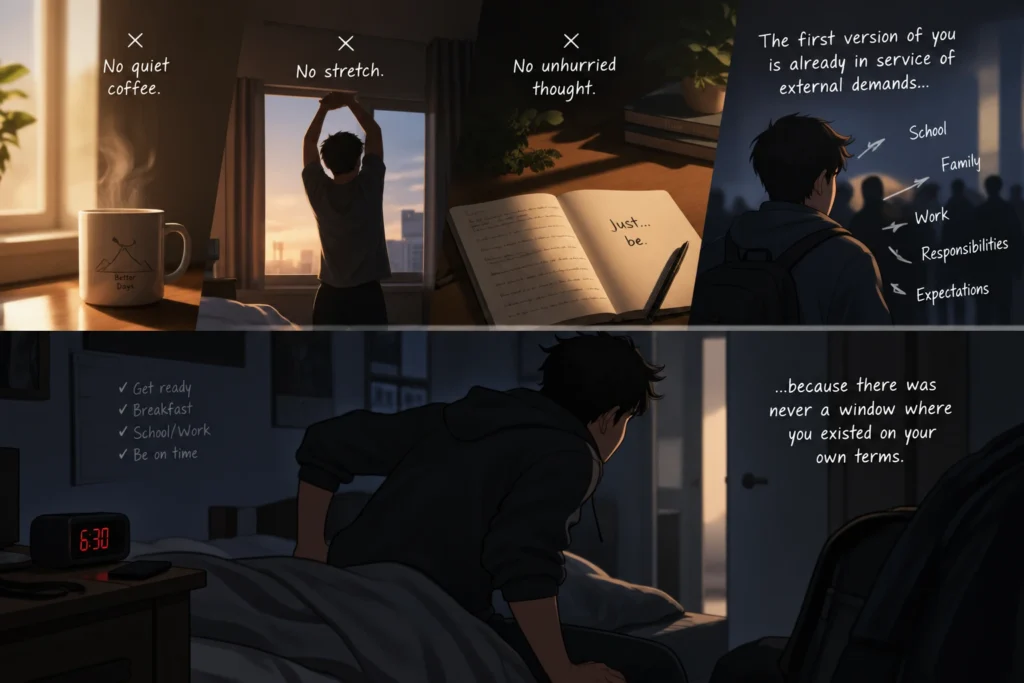
Perhaps the biggest cost of the rushed morning is what gets skipped: any moment that belongs to you before the day starts belonging to everyone else. No quiet coffee. No stretch. No unhurried thought. The first version of you that shows up each day is already in service of external demands, because there was never a window where you existed on your own terms.
This adds up to something subtle but significant: a life where you rarely feel like the author of your own time, because the very first moments of every day already belong to something outside yourself.
Why “Just Wake Up Earlier” Doesn’t Solve It
Many people try to fix this by simply setting an earlier alarm, only to fill the extra time with the same rushed, reactive behavior — just starting sooner. The problem was never really about the number of minutes available. It’s about what those minutes are spent on, and whether they include any space for stillness before the demands begin.
How to Build a Slow Morning
Redesigning the First Twenty Minutes
You don’t need an elaborate two-hour morning routine to change this. You need a small, protected window at the start of the day that belongs to you before it belongs to anything else.
1. Delay the Phone, Even by Ten Minutes
The single highest-leverage change is simple: don’t let your phone be the first thing you engage with. Even a ten-minute delay changes the entire tone of the morning, because you get to have your own first thought instead of reacting to someone else’s.
2. Wake Up Before You Have To
If your current wake time leaves zero margin, you’re guaranteeing a rushed start no matter what else you change. Even fifteen extra minutes, used deliberately, creates enough space for a transition instead of an ambush.
3. Do One Slow Thing on Purpose
Pick a single unhurried anchor — making coffee without multitasking, sitting by a window, stretching for a few minutes — and protect it fiercely. It doesn’t need to be elaborate. It needs to be slow, and it needs to be yours.
4. Get Dressed and Ready Before You’re Rushed
A significant source of morning panic is doing essential tasks — showering, dressing, packing a bag — under time pressure. Where possible, shift these earlier, so the final stretch before leaving is spent transitioning calmly rather than scrambling.

5. Let the First Thought Be Chosen, Not Given
Before reaching for external input, spend even a minute with an internal one: an intention for the day, a moment of simply noticing how you feel, a breath without an agenda attached. This small act reclaims authorship over how your day begins.
6. Prepare the Night Before
Much of morning chaos is actually last night’s undone decisions arriving with interest. Laying out clothes, prepping what you can, and deciding your first task in advance removes friction that would otherwise eat into your slow window the next day.
A Day That Starts on Your Terms
A slow morning isn’t about becoming a different kind of person, or having infinite free time before work. It’s about reclaiming a small, protected space at the edge of the day that belongs to you before it belongs to your inbox, your notifications, or anyone else’s expectations.
The way you begin a day tends to echo through the rest of it. Twenty unhurried minutes, spent well, can be the difference between a day you’re dragged through and one you actually get to live.
Related Posts
- Information Overload: Why You Feel Exhausted Without Doing Anything
- Digital Minimalism: Reclaiming Your Attention in a Noisy World
- Financial Minimalism: How to Escape Money Anxiety and Build True Freedom








Pingback: Financial Minimalism: How to Escape Money Anxiety and Build True Freedom – the calm living
Pingback: Doing Nothing on Purpose: Why Rest Isn’t Laziness – the calm living
Pingback: Digital Minimalism: Reclaiming Your Attention in a Noisy World – the calm living