
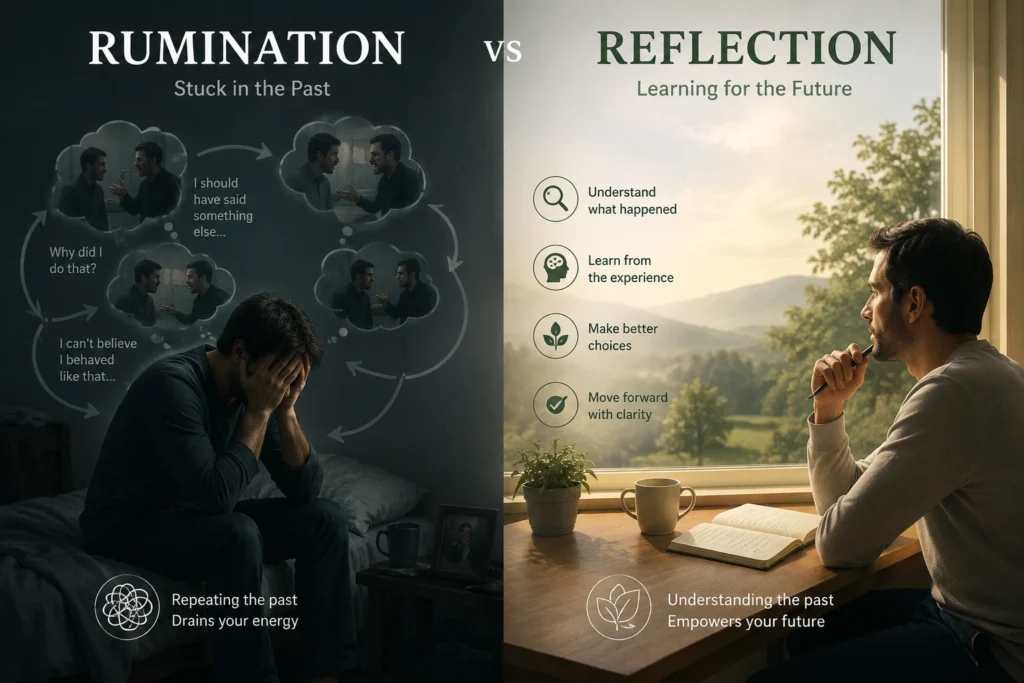
You replay the conversation for the tenth time. The one where you said something slightly awkward, or where your boss’s tone seemed a little off. You turn it over and over, searching for a different ending, a better version of yourself, an explanation that makes the discomfort go away.
It never does.
Also Read: Why Some Relationships Drain You (Even When Nothing’s “Wrong”)
Somewhere along the way, we were taught that thinking deeply about our problems is always a good thing. That the more we examine our mistakes, our relationships, our failures, the closer we get to understanding — and eventually, to peace. But there’s a quiet trap hiding inside that belief. Not all inward-looking thought is created equal. Some of it heals. Some of it just keeps you circling the same drain, convinced you’re making progress because it feels productive.
This is the difference between rumination and reflection — and learning to tell them apart might be one of the most important mental skills you ever develop.
Mistaking Rumination for Insight
Rumination feels like thinking. It has all the trappings of it — internal dialogue, analysis, replaying details, searching for answers. But rumination isn’t thinking toward something. It’s thinking around something, again and again, without ever landing.
Psychologists describe rumination as a repetitive, passive focus on the causes, meanings, and consequences of distress — without any real forward motion. You ask “why did this happen to me?” or “why am I like this?” but the question never resolves. It just loops. You’re not solving anything; you’re rehearsing the pain.
The insidious part is that rumination disguises itself as responsibility. It tells you that if you just think about it a little longer, a little harder, you’ll finally understand — and understanding will bring relief. So you keep going. You replay the argument with your partner one more time. You re-read the text message, searching for a hidden meaning. You lie awake dissecting a decision you made five years ago that can no longer be changed.

Most people don’t even realize they’re doing it. Rumination often masquerades as:
- “Processing” a problem, when really you’re stuck rehashing it
- Self-reflection, when it’s actually self-criticism on a loop
- Trying to “figure out” someone else’s motives, when there’s no new information to work with
- Worrying about the future disguised as “planning”
And here’s the cost: research consistently links rumination to worsened mood, prolonged sadness, higher anxiety, and even a greater risk of depression. It doesn’t just fail to help — it actively deepens the very distress it claims to examine. The mind, convinced it’s working toward a solution, is actually just wearing a groove deeper into the same worn path.
The Toll of a Mind That Won’t Let Go
If rumination were harmless, this wouldn’t matter much. But it isn’t harmless — it’s exhausting, and it quietly reshapes how you experience your own life.
Think about the last time you got stuck in a rumination spiral. Maybe it was after a disagreement with a friend, or a mistake at work that kept you up at night. Notice how it felt: the tightness in your chest, the same three sentences repeating in your head, the sense that you should be able to think your way out of this if you just tried a little harder. That effort rarely pays off. Instead, it often leaves you more anxious than before you started, because rumination has a way of amplifying threat. Each replay convinces your nervous system that the situation is more dangerous, more shameful, or more unfixable than it actually is.
Over time, this pattern doesn’t stay contained to one bad night or one difficult week. Chronic ruminators often report:
- Difficulty sleeping, because the mind won’t power down
- Strained relationships, since rumination frequently spills into seeking reassurance or replaying conflicts out loud with others
- A shrinking sense of agency — the more you ruminate, the more life feels like something happening to you rather than something you’re moving through
- Physical fatigue, as the body responds to repetitive negative thought much like it responds to real, ongoing stress
Perhaps the cruelest part is the illusion of control. Rumination convinces you that if you stop thinking about the problem, you’re being careless — that vigilance equals virtue. So even when it drains you, some part of you resists letting go, afraid that release means you don’t care enough, or that the issue will sneak up on you if you’re not constantly rehearsing it.
But there is a way out. It doesn’t involve refusing to think about hard things. It involves changing how you think about them.
Turning Rumination Into Reflection
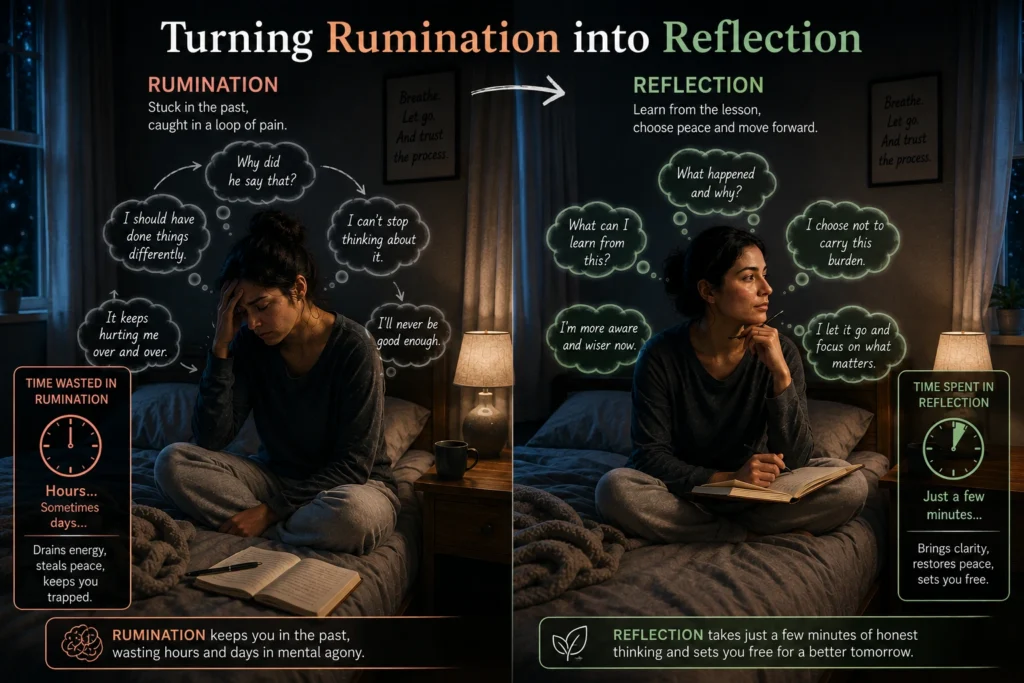
Reflection looks similar to rumination from the outside — both involve looking inward, thinking about difficult experiences, sitting with discomfort. But the internal experience, and the outcome, are entirely different.
Where rumination asks “why did this happen to me?” reflection asks “what can I learn from this?” Where rumination stays passive, circling the same unanswerable question, reflection is active — it moves toward clarity, decisions, and eventually, release. Reflection has a destination. Rumination just has a loop.
Here’s how to start shifting from one to the other:
1. Notice the loop, not just the content. The first step isn’t changing what you’re thinking about — it’s noticing that you’re looping. Ask yourself: “Am I learning something new each time I think about this, or am I replaying the same three thoughts?” If nothing new is emerging, that’s your signal you’ve slipped into rumination.
2. Give your thinking a job. Reflection works best with a clear question attached to it. Instead of open-ended dwelling, try: “What is one thing I would do differently next time?” or “What does this reveal about what matters to me?” A focused question gives your mind somewhere to go, rather than somewhere to circle.
3. Set a container for the thought. Give yourself permission to think about the issue — but within limits. Some people find it helpful to write for ten minutes, set a timer, and then consciously close the notebook. This isn’t suppression; it’s structure. Rumination thrives on infinite space. Reflection thrives on boundaries.
4. Externalize it. Thoughts that stay in your head tend to loop; thoughts that hit paper tend to move. Journaling, talking to a trusted friend, or even speaking your thoughts aloud to yourself can interrupt the internal echo chamber and turn vague anxious energy into something you can actually examine and set down.
5. Ask what action, if any, is available. Reflection often ends with a small next step — an apology to offer, a boundary to set, a lesson to carry forward. Rumination has no next step, because it isn’t actually trying to arrive anywhere. If your thinking keeps producing “there’s nothing I can do about it” alongside continued dwelling, that’s rumination. If it produces even one small, actionable insight, you’re reflecting.
6. Practice self-compassion instead of self-interrogation. Rumination often runs on harsh internal language — “why am I so stupid,” “I always mess this up.” Reflection uses gentler, more curious language — “that didn’t go the way I wanted; what would help next time?” The tone of your inner voice matters as much as the content of your thoughts.
7. Return to the present. Rumination almost always drags you into the past or catapults you into hypothetical futures. Grounding practices — noticing your breath, feeling your feet on the floor, naming five things you can see — aren’t a way of avoiding the problem. They’re a way of reminding your nervous system that right now, in this moment, you are safe enough to think clearly instead of anxiously.

The Mind You Can Trust
Not all inward attention is self-care. Sometimes it’s self-sabotage wearing the mask of diligence. Learning to recognize when you’ve slipped from reflection into rumination is a quiet but powerful form of self-awareness — one that protects your peace far more than any amount of extra analysis ever could.
The next time you catch yourself replaying a moment for the fifth or sixth time, pause and ask: is this thought moving me forward, or just keeping me company in the same place? That single question might be the difference between a mind that heals and a mind that hurts.
Related Posts
- People-Pleasing vs. Genuine Kindness: Why They Feel the Same and Aren’t
- How to Get Along with others: A guide for better relationships
- Practicing Compassion in Speech: Avoiding Gossip, Harsh Words, and Unnecessary Commentary








Pingback: The Art of the Body Scan: Releasing Hidden Physical Stress – the calm living
Pingback: Numbness vs. Peace – the calm living
Pingback: Emotional Regulation: The Power of Pausing Between Stimulation and Reaction – the calm living
Pingback: Transforming Suffering: How the Vow of Non Harming Restores Inner Peace – the calm living
Pingback: Meditation for Beginners and Committed Meditators – the calm living