Introduction to Meditation

Meditation is an ancient practice widely used across the world to cultivate calm and inner peace by slowing down internal dialogue and hushing the constant flow of thoughts. There are hundreds of meditation techniques practiced across different traditions and cultures, ranging from sitting meditation, living meditation to active or dynamic forms.
Also Read: Beyond the Mind: A Beginner’s Guide to Self-Inquiry
The Ultimate Goal of Meditation
The ultimate goal of meditation is to realize a permanent, unshakable state of inner peace and bliss. While reaching this ultimate state requires dedicated long-term practice, every single session brings you closer to lasting calm.
There Is No Single Best Technique
I have wasted years of my life searching for the “best” meditation technique. I kept constantly changing methods, and I want you to avoid doing the same. No single technique is considered the best. In fact, almost any technique can work, depending on your needs, your lifestyle, and how easily you can practice it every day. You can try a few different techniques to find the one that suits you, but searching endlessly for the best one is a waste of time. Choose the technique you like most and let it take you deeper into consciousness. It is also normal to try another technique after a few weeks, just to avoid boredom and monotony and then return to your previous method.
Behind the Sense of “I”
The Mind is the part of a person that thinks, feels, remembers, and reasons. it holds a huge collection of thoughts. Within us, it manifests as the sense of “I” and functions like a distinct entity, though it is not one. This is why traditional meditation places so much emphasis to go within so as to reach the core. Holding your attention firmly on this sense of self, helps immediately pause the flow of stray thoughts and inner chatter.
States of Mind
The highest state of Being is pure awareness, profound consciousness and unshakable everlasting bliss and “The Peaceful Mind” is an essential precursor and foundational doorway to it. Most people spend their lives stuck in specific emotional states—such as anger, resentment, fear, sadness, or grief—which directly impact their physical health and overall well-being. Regardless of your current mental state, meditation gradually brings you closer to the state of peace by slowing down your thought process and quieting the mind’s inner dialogue.
The Unrestrained Mind
A vast number of people suffer and lack inner serenity because of an unrestrained mind. Your body operates with your consent: you move your legs when you want to walk, and you use your tongue when you want to speak. Ideally the mind ought to stay passive and quiet until needed and called upon, yet it operates entirely on its own. The mind is a quiet instrument waiting to be used and activates only on command, yet left to itself, it wanders unrestrained. You do not want your mind to wander aimlessly, constantly dredging up painful memories against your will.
Consider times when you felt insulted, dismissed, or made to feel inferior. Even when you consciously want to rest, forget the incident, and move forward, an unrestrained mind acts differently. It replays the trauma repeatedly against your will—refighting past arguments and seeking imaginary retaliation for days on end. You could be driving your car, completely at ease, when the mind suddenly resurrects the years old memory and disrupts your peace.
Brain Wave Optimization
From neurological perspective, deep peace corresponds with slower, highly synchronized brain waves (like alpha and theta), which naturally precede the deep clarity associated with transcendental states.
Letting go of Desires
Desires create restlessness. Thoughts feed these desires by repeatedly replaying the objects of your wanting. Without thoughts to fuel a desire, that desire loses its power over you. Whenever a desire-based thought arises, simply reject it and let it go without giving it your energy.
How to Practice Meditation
Live Meditatively All Day
Meditating for an hour or so a day is not enough on its own. The aim is to live a meditative life. This may seem difficult, but persistent effort makes it easier. All you need to do is remain aware of I Am, no matter what you are doing, whether sitting, standing, walking, talking, praying, or working. Stay mindful of your own presence. When you remain self-aware amid your daily activities then whatever you do you do it consciously, grace and dignity shine through your every action and speech.
Remain aware of “I am” from the moment you wake up in the morning until you close your eyes at night. You will inevitably lose yourself in thoughts at times, and that is to be expected. What matters is how quickly you return to the meditative state. As soon as you realize your mind is wandering, bring your attention back to self-awareness. Alongside living meditatively, include a daily seated session of 30 to 40 minutes. It will significantly accelerate your progress toward complete awareness. In fact, the two practices reinforce each other and keep you on track.
Breath Meditation For Beginners
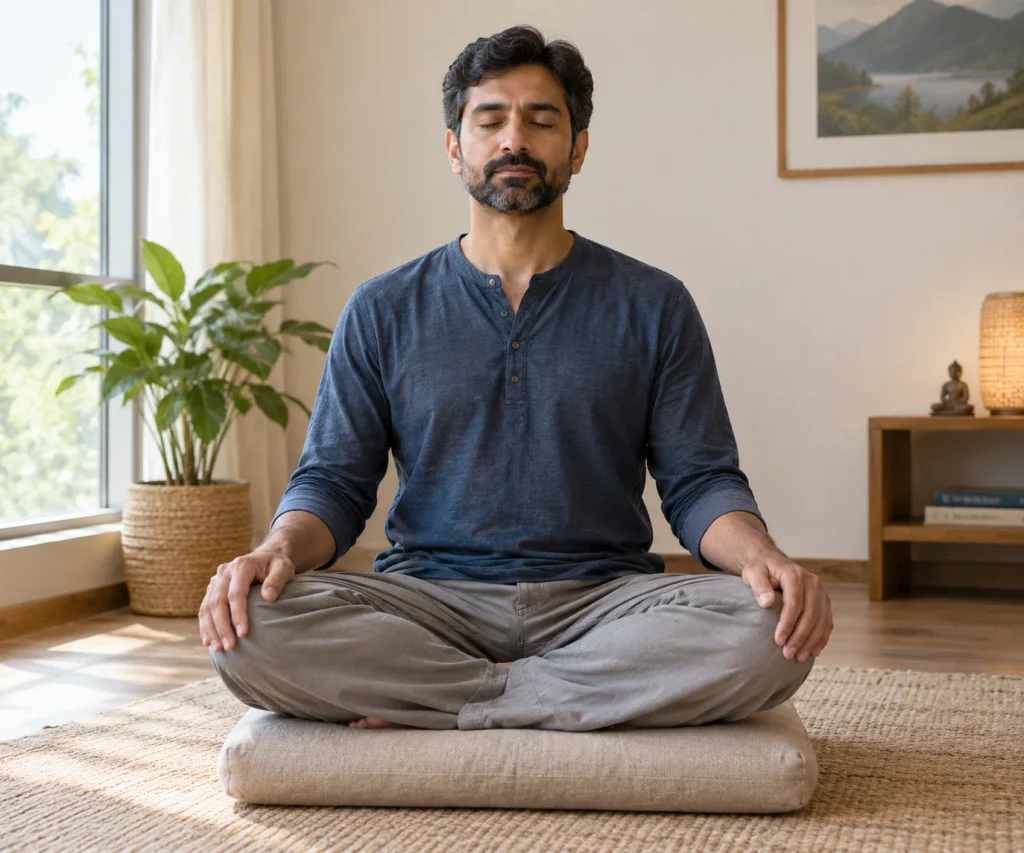
Find a quiet space: Sit comfortably in a peaceful environment.
Sitting posture: Keep your spine straight yet relaxed. Sit on the edge of a chair or cushion so your hips are slightly higher than your knees.
Focus on the breath: Close your eyes and focus your attention on your breathing.
Notice the physical sensation: The air entering and leaving your nose or mouth.
Duration: Aim for 10 to 20 minutes daily.
Do not try to change your natural breathing rhythm. Gently bring your focus back to your breath whenever your mind wanders.
“I AM” Meditation For Committed Meditators
Find a quiet space: Sit comfortably in a peaceful environment.
Sitting posture: Keep your spine straight yet relaxed. Sit on the edge of a chair or cushion so your hips are slightly higher than your knees.
Rest hands: Place your hands gently on your knees or in your lap.
Close eyes: Close your eyes to turn your attention away from the outer world.
Drop thoughts: Let go of all past memories, future plans, and daily worries.
Find the feeling: Direct your focus to the pure sense of being alive, the non-verbal feeling of “I Am”.
Hold the focus: Rest your mind quietly in the simple fact that you exist, without adding any names, forms, or labels to it.
Duration: 30 to 40 minutes daily.
Do not strain, keep the attention effortless, like a gentle listening or waiting in silence.
Realize that the “I am” feeling is your true nature, shining before the mind wakes up.
The Key to Meditation
The secret to meditation practice is simply the act of returning. Thoughts will naturally arise. Whenever a thought appears, do not engage with it or invest interest in it. Gently and swiftly return your focus to the sense of “I Am” or your breath.
Related Posts
- The Art of the Body Scan: Releasing Hidden Physical Stress
- The Practice of Deep Listening: How to Hear Others Without Formulating a Response
- Transforming Suffering: How the Vow of Non Harming Restores Inner Peace
- Rumination vs. Reflection: Why One Heals and the Other Hurts








Pingback: The Art of the Body Scan: Releasing Hidden Physical Stress – the calm living
Pingback: Beyond the Mind: A Beginner’s Guide to Self-Inquiry – the calm living
Pingback: 15 Good Habits for a Happier, Calmer, and More Peaceful Life – the calm living
Pingback: Emotional Regulation: The Power of Pausing Between Stimulation and Reaction – the calm living
Pingback: Turning Mundane Chores into Moving Meditation – the calm living