

Self-remembering means staying fully aware of yourself and your actions or environment in the present moment. This daily practice helps you stops automatic habits, lowers stress, and brings deep calm. It gives you a clear mind to make better choices all day long.
Also Read: Meditation for Beginners and Committed Meditators
There is a quiet condition running underneath almost every human life: we have forgotten over selves. We have forgotten that we exist, we are here, right now. This forgetting is not something modern life invented, it is older and deeper.
Busyness does not cause it; busyness is simply the shape it takes today, the noise that makes it easy not to notice. Whether it is financial pressure, working hard to pay bills, rent, school fee or the opposite weight of running a business and chasing the next target, the underlying self-disconnection is the same. Someone earning just enough can be living self-aware; someone with every resource in the world can be entirely absent from their own self. This is not the problem of income or status- it is the problem of attention, and it touches everyone, from the employee to the executive.
Waking up from Automatic living

Because we have disconnected from Over selves, we live an automatic life. A robotic life. As if we are asleep even while awake. Whatever we do, we rarely do it consciously- not because we are too busy to, because we have lost the habit of noticing we are doing it at all. Most of our day is thought-driven, monotonous activity, moving through routines on autopilot, reacting rather than living. But when we act consciously, whatever we do – no matter how small- carries a certain grace. It holds freedom from automatic habits, and it holds responsibility.
This is the essence of self-remembering: choosing to be self-aware, on purpose, in the middle of your own life. It is not about adding one more task to an already overloaded schedule. It is about changing the quality of attention you bring to what you are already doing, so that you are actually living it instead of sleepwalking through it.
The benefits of Self -Remembering

Clarity
When you practice self-remembering, you begin to see the truth of a situation clearly without the distortion of blind anger or sudden fear. You respond to life as it actually is, not as your reactive mind interprets it in the heat of the moment.
Freedom
Self-remembering breaks old, harmful loops. The habits and patterns that once ran your life on autopilot lose their grip, and you become free to choose fresh paths instead of repeating the same automatic responses.
Happiness
Perhaps most importantly, you begin to genuinely enjoy your actions in the present moment, the memory of a past success, not the anticipation of a future reward. You are quite satisfied of being fully in what you are doing right now.
You Speak Precisely
When you start speaking consciously, there is a new calm in your speech. Your words become clear and easy to understand. You are no longer just transmitting a message-you are also able to genuinely understand the other person’s point of view. Communication stops being a reflex and becomes a real exchange.
You become Real
There is a subtler benifit too- one that shows up not in you, but in how others experience you. People around you feel the change. They start loving and respecting you differently, because presence has a kind of magnetism. When you are truly there, people notice, even if they can’t explain why.
Common Misconceptions
A natural objection arises here: If I put all my attention on myself, how can I still focus on my work?
You are not required to put all your attention on yourself, it is a divided attention technique, when you practice self-remembering, your attention sub divided to you and your action or surrounding. People become more efficient at their work, not less.
Why my life is not in good shape? I am facing a lot of problems therefore I am not happy.
It is just a story your mind tells itself. In reality, your life is a reflection of your own mind. Once you become conscious, and your restless mind settles, your happiness and peace restored.
What the Research shows
This is not just a philosophical claim. A landmark 2010 study in the journal Science, by Harvard psychologists Mathew Killingsworth and Daniel Gilbert, found that people’s minds wander about 47% of the time across nearly all daily activities.
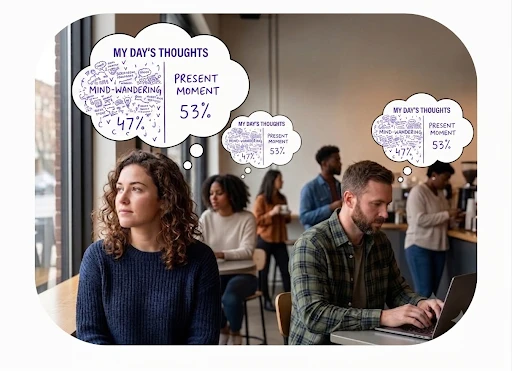
And this percentage increases to 65% when they are doing their personal tasks like eating bathing etc… So, it is important to make all your efforts to stay aware while completing your personal tasks, eat consciously.
Their analysis suggested this mind-wandering was generally the cause of unhappiness, not simply a symptom of it. We don’t drift into thoughts because we are unhappy; we become unhappy because we drift into thoughts, disconnected from what’s actually in front of us.
How to Practice Self-remembering
The practice itself is simple to describe, even if it takes real effort to sustain:
All you have to do is to put half of your attention to yourself and half to your action and surrounding. The essential technique is divided attention: holding awareness of your own presence while simultaneously remaining aware of the external task or environment.
The 50/50 spilt: Directing 50% of your attention outward toward what you are doing (talking, walking, typing) and 50% inward toward your own physical presence (“I am here doing this”)
Double Arrow of Attention: Picturing awareness pointing in two directions at once-one arrow pointing toward the object/action, and the other pointing back toward the observer (yourself)
Anchoring in the Body: Using physical sensation (like feeling your feet on the floor or the rhythm of your breath) as the inward anchor while carrying out your outer activity.
To master the art of self-remembering, it helps to build a foundation through daily Meditation. Self-remembering is an active effort, but sitting in silent meditation each day prepare your mind for that effort. Both techniques support each other; they work vice versa.

It won’t happen all at once. It’s a discipline you return to again and again throughout the day. But each time you catch yourself and come back to the present, you strengthen a mental muscle most of us have left completely untrained.
The key is returning
The constant flow of thoughts does not slow down immediately. You need to always return to yourself. When you find yourself being lost in thoughts quickly return to self-remembering.
The Roots of the Practice: Gurdjieff and Ouspensky

Though the concept of Self-awareness is very old however these two philosophers gathered ancient esoteric ideas and brought them to the World. Self-remembering is the central practice of their teachings.
The Takeaway
Self-remembering isn’t a complicated technique or a rigid regimen. It’s a return-to the eating, walking, talking, working life you’re already living, but live with awareness. Start small. Pick one activity today and simply notice that you are the one doing it. That single act of noticing is where everything else begins.
You don’t need a quiet room or free time you don’t have. This practice fits inside the busy life you already have-it doesn’t ask you to escape it. Over time, these small moments of noticing add up, and the automatic, half-asleep quality of daily life gives way to something steadier and more awake.
Related Posts
- Beyond the Mind: A Beginner’s Guide to Self-Inquiry
- The Practice of Deep Listening: How to Hear Others Without Formulating a Response
- Rumination vs. Reflection: Why One Heals and the Other Hurts
- Solitude vs. Loneliness: Why They’re Not the Same Thing








Pingback: The Art of the Body Scan: Releasing Hidden Physical Stress – the calm living
Pingback: Beyond the Mind: A Beginner’s Guide to Self-Inquiry – the calm living
Pingback: Emotional Regulation: The Power of Pausing Between Stimulation and Reaction – the calm living
Pingback: Solitude vs. Loneliness: Why They’re Not the Same Thing – the calm living