
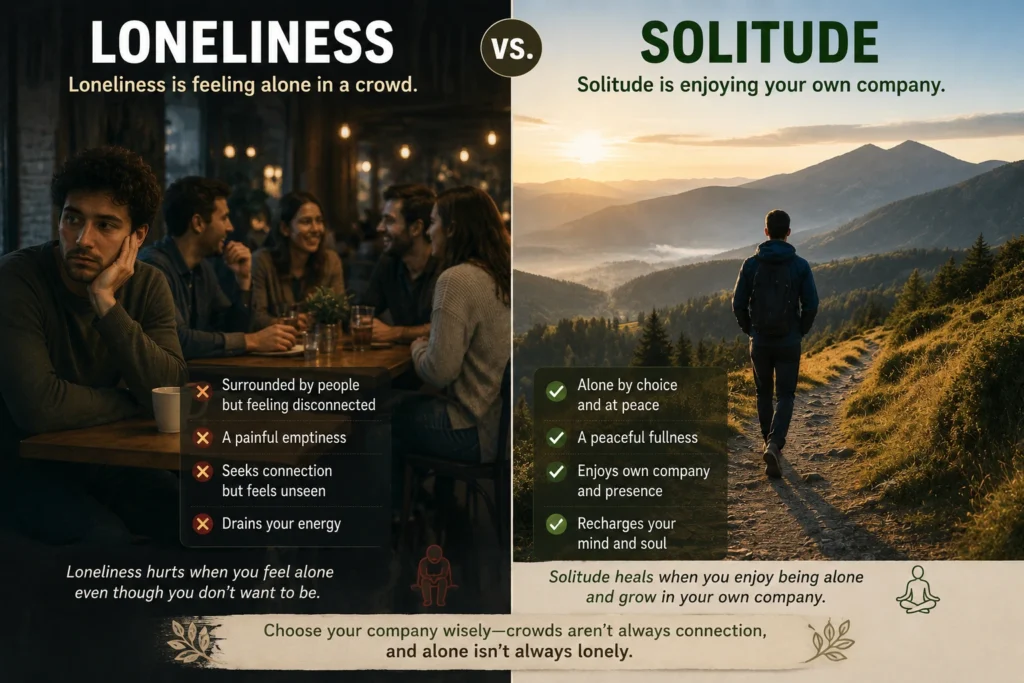
You can feel completely alone in a room full of people. And you can sit by yourself for an hour and feel more at peace than you have all week. If both of these are true, then being alone clearly isn’t the problem — and being surrounded by others clearly isn’t the cure. The real difference lies somewhere else: in whether the aloneness was chosen, and what it’s doing to you.
Also Read: Doing Nothing on Purpose: Why Rest Isn’t Laziness
Two Different Experiences, One Confusing Word
Loneliness is an ache. It’s the feeling of missing connection you want but don’t have — a gap between how close you feel to others and how close you’d like to feel. You can be lonely at a party, lonely in a marriage, lonely in a group chat that never quite says anything real.
Solitude is different. It’s space you choose, not connection you’re missing. It’s the quiet after you’ve closed the laptop, the walk you take without your phone, the morning coffee before anyone else is awake. Nothing is missing in solitude — if anything, something finally has room to surface: your own thoughts, undisturbed.
The two can look identical from the outside. Someone sitting alone at a café might be quietly recharging, or they might be aching to be somewhere else, with someone else. The difference isn’t the scene. It’s what’s happening internally.

Why We Confuse the Two
Most of us are taught, without ever being told directly, that being alone is something to fix. Silence gets filled with a podcast. A quiet evening becomes an evening scrolling. Even short waits — in line, on a train — get filled with a screen. Over time, alone starts to feel like a problem waiting for a solution, rather than a state that might be fine, or even good, on its own.
This makes it hard to tell whether we’re craving company or just avoiding stillness. A person might interpret restlessness as loneliness and reach for company, when what they actually needed was space to think. Conversely, someone who is genuinely lonely might mistake their discomfort for something solitude alone can’t touch — no amount of quiet time fixes a real absence of connection.
Knowing which one you’re facing matters, because the remedies are opposite. Loneliness asks you to reach out. Solitude asks you to stay put.
What Solitude Actually Gives You

When solitude is chosen rather than avoided, it tends to offer a few specific things:
Clarity. Thoughts that get drowned out by noise and company have room to finish forming. Decisions that felt tangled often untangle themselves in quiet.
Self-trust. Constant company can quietly train you to check your reactions against others before you’ve even had them. Solitude gives you a chance to notice what you actually think, before anyone else weighs in.
Recovery. Being around people, even people you love, takes energy. Solitude is where that energy gets replenished — which is part of why the same amount of “alone time” can feel restorative to one person and unbearable to another; introversion and extroversion shape how much solitude a person needs, not whether it’s valuable at all.
None of this requires isolation. An hour of chosen quiet in an otherwise full week does the job.
Making Room for Solitude
Solitude doesn’t need a retreat or a drastic life change. It tends to show up in small, repeatable pockets:
- A walk without headphones or a phone
- Ten minutes with coffee before checking any screen
- One meal eaten without a show playing in the background
- Journaling for five minutes without an agenda for what to write

The goal isn’t to enjoy every second of it right away. Sitting with your own mind can feel uncomfortable at first, especially if it’s unfamiliar. That discomfort usually fades with practice — and often, what’s on the other side of it is exactly the clarity you didn’t know you were missing.
How to Overcome Loneliness
If solitude is a resource you build by staying put, loneliness is a signal that asks you to move — toward people, toward honesty, toward risk. That’s often exactly what makes it hard to act on. Loneliness has a way of making connection feel both more necessary and more difficult at the same time, which is why so many people sit with it far longer than they need to. Here’s what actually tends to help.
Name it before you try to fix it. Loneliness thrives on being vague. It shows up as irritability, low motivation, or a general flatness that’s easy to blame on being tired or busy. Naming it plainly — “I’m lonely right now” — does something small but real: it turns a fog into a problem, and problems can be worked on. Without that naming step, people often try to treat loneliness with productivity, sleep, or scrolling, none of which touch the actual gap.
Start with contact, not closeness. One of the biggest traps in overcoming loneliness is waiting for a deep, meaningful connection to appear before making any effort. That bar is too high to clear from a standing start. Low-stakes contact — texting an old friend, chatting with a barista, joining a group activity where talking isn’t mandatory — rebuilds the muscle of being around people. Depth tends to follow frequency, not the other way around.
Reach out before you feel ready. Loneliness often comes with a quiet story that nobody would want to hear from you right now, or that reaching out would be a burden. That story feels true precisely because loneliness makes it harder to accurately judge how welcome you are. Most people are glad to be reached out to. Sending the message before you feel fully ready is usually the difference between staying stuck and starting to move.

Be honest about the quality of your connections, not just the quantity. It’s possible to be surrounded by people and still feel the ache of loneliness, because the contact you’re getting doesn’t match what you actually need. If that’s the pattern, the fix isn’t more plans — it’s more honest ones. That might mean telling a friend what’s actually going on in your life instead of keeping things surface-level, or stepping back from relationships that leave you feeling more alone than being by yourself would.
Watch for the withdrawal loop. Loneliness has a way of feeding itself: the longer it goes on, the less energy there is to reach out, which deepens the loneliness, which drains more energy. Breaking this loop rarely requires a big gesture. A single small action — one message sent, one invitation accepted — is often enough to interrupt the cycle, even if it doesn’t resolve the whole feeling in one go.

Know when solitude is making it worse. Because solitude and loneliness can look identical from the outside, it’s easy to keep choosing more alone time under the belief that it will eventually feel peaceful, when what’s actually needed is people. If time alone consistently leaves you feeling worse rather than recharged, that’s a sign the ache is loneliness, not a need for more quiet — and the answer is to move toward others, not further inward.
Consider that persistent loneliness may need more than self-help. Occasional loneliness is a normal part of life and usually responds to the steps above. But loneliness that’s constant, long-lasting, or tied to a broader sense of disconnection from life can be worth bringing to a therapist or counselor. There’s no failure in that — it’s simply recognizing that some gaps are better closed with support than worked through alone.
Look for structure, not just company. Connection is easier to sustain when it’s attached to something recurring — a class, a sport, a volunteer shift, a standing weekly call. Structure removes the need to constantly initiate from scratch, which is often the most draining part of being lonely. A once-a-week commitment, chosen deliberately, tends to do more over a few months than several one-off attempts at socializing.
The Real Takeaway
Loneliness is a signal that something is missing and worth addressing — through connection, honesty, or reaching out. Solitude is a resource, one that’s often sitting unused because it’s been mistaken for something to avoid.
Learning to tell them apart is less about analyzing your feelings and more about paying attention: when you’re alone, are you missing something, or are you finally getting something back? The answer changes what you should do next — and it’s usually clearer than it first appears.
Related Posts
- The Practice of Deep Listening: How to Hear Others Without Formulating a Response
- Numbness vs. Peace
- Self Remembering: Deepening Presence








Pingback: The Freedom of Surrender: Knowing When to Stop Controlling Outcomes – the calm living
Pingback: Self Remembering: Deepening Presence – the calm living
Pingback: 15 Good Habits for a Happier, Calmer, and More Peaceful Life – the calm living
Pingback: Transforming Suffering: How the Vow of Non Harming Restores Inner Peace – the calm living
Pingback: Emotional Regulation: The Power of Pausing Between Stimulation and Reaction – the calm living
Pingback: Financial Contentment: Moving Beyond the Impulse to Continually Upgrade – the calm living